
PEDIGREE STUDENT BREEDS MULTIPLE STAKES WINNER MAN O ROSE
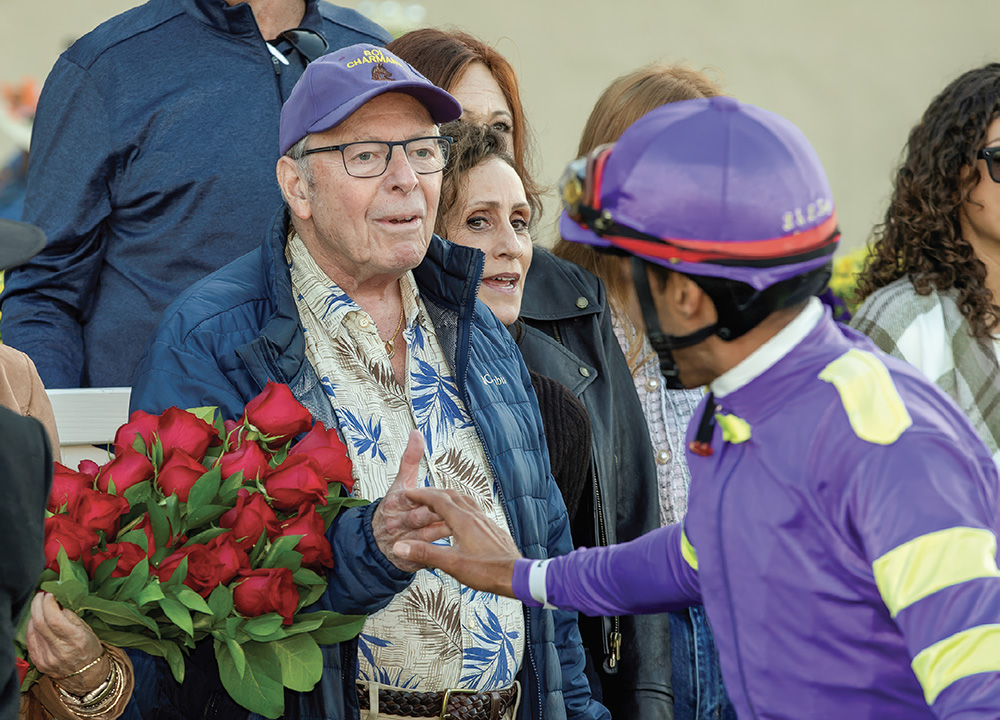
Owner/breeder Bruce Zietz celebrates one of Man O Rose’s wins with jockey Edwin Maldonado
Dr. Bruce Zietz has ardently studied the art of horse breeding for decades, and in Man O Rose, the retired physician believes he finally has his masterpiece.
His 5-year-old California-bred gelding has won three consecutive stakes since mid-September, all in impressive style for trainer Jeff Mullins. The bay son of Stanford headed into December with 10 wins from 17 lifetime starts and earnings of nearly $500,000.
Zietz knows that any horse that wins close to 60% of his races over a span of three years is something special. He says he and Mullins have taken their time developing Man O Rose, consistently keeping him in state-bred or restricted company in order to extend his longevity.
“He’s my creation,” said the 86-year-old Zietz, who bred his first horse—multiple stakes winner Patrick McFig—in 1979. “I was not a great artist. I never wrote music. I was a history major. Everybody wants to leave a legacy of some kind, and maybe this horse can do some things that people will remember for a long time. I’ve been carefully honing this for 30 years at least.”
Zietz, who lives in the San Fernando Valley community of West Hills, made his mark in the field of cancer treatment. After receiving his medical degree from the University of California at Berkeley in 1965, he became the first oncologist-hematologist in the San Fernando Valley, he said. At its height, his practice treated up to 25 people daily at hospitals such as Cedars-Sinai Medical Center and UCLA, plus another 40 patients at his office.

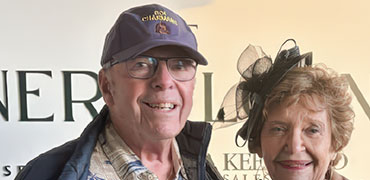
Zietz with former high school sweetheart Rhoda Rosen
His wife, Beverly, died about 2½ years ago. Since her death, Zietz reconnected with his former high school sweetheart, Rhoda Rosen.
When he stepped aside and sold his flourishing practice after 38 years, Zietz had more time to devote to breeding horses. While never owning more than a few broodmares at any one time, he was heavily influenced by the works of the brilliant Italian breeder Federico Tesio and, perhaps more importantly, Marianna Haun.
“Tesio trained his horses and he bred them to weed out their flaws,” Zietz said. Tesio’s work introduced Zietz to the idea of line breeding, simply defined as the presence of a top ancestor twice or more in a horse’s pedigree with at least one strain present from each parent.
“He bred for soundness,” Zietz said. “He also believed that great racing mares are not great producers. But their daughters can be.”
Following the death of Secretariat in 1989, the horse’s autopsy revealed that the 1973 Triple Crown champion had a 23-pound heart, much larger than the average Thoroughbred, Zietz notes. Haun’s research for a genetic connection between the size of a horse’s heart and exceptional performance resulted in the 1997 book The X Factor, Solving the Mystery of Secretariat’s Heart.
In it, as well as in subsequent books, Haun argued that the gene responsible for the large heart is linked to the X chromosome traceable back to Eclipse and detailed how to find it. She identified four classic stallions that carry the “Big X”—War Admiral, Princequillo, Blue Larkspur, and Mahmoud. Mating breeding prospects that carry the pedigrees of those stallions on both sides greatly enhanced the likelihood that a foal can possess the “big heart.”
Zietz’s study also led him to appreciate the importance of the female’s breeding line over the stallion line. He says he rejects “dogma” in the horse industry in much the same way he rejected it in the field of cancer treatment.
With its reliance on hot stallions to boost sales prices, he believes the U.S. breeding industry is “usually simplistic and often wrong. They are breeding on the basis of selling horses, not racing them.”
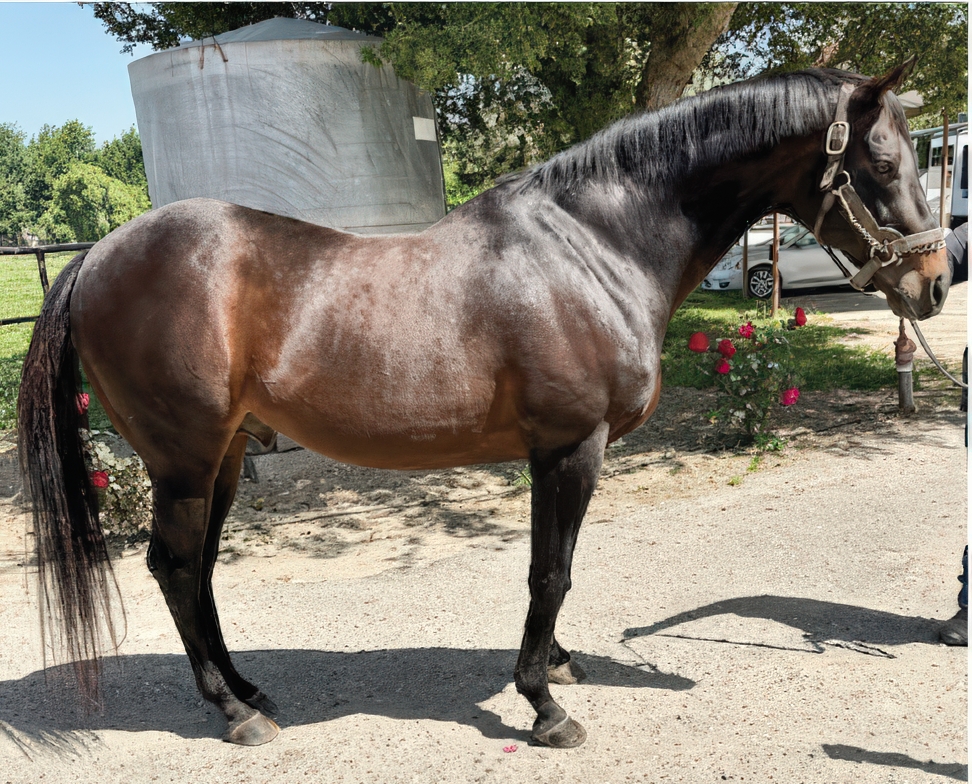
Roi Charmant comes from Man O Rose’s family
Man O Rose’s story began with his third dam, Cantina, acquired by Zietz and a partner in foal to Evansville Slew at a Kentucky breeding stock sale in 2001 for $5,500. That mating produced Roi Charmant, a resilient front-running sprinter who banked $337,678 for Zietz. Now 24, Roi Charmant stood in California for many years and is now pensioned at Kingfisher Farms.
“Cantina had been injured, but her trainer, Rodney Rash, the former assistant to Charlie Whittingham, told me she could really run,” Zietz said. “She was a blocky mare, a little toed out, and her first few foals were crooked. The thing about her was she was a daughter of Seattle Dancer, a half brother to (1977 Triple Crown winner) Seattle Slew that sold for $13.1 million as a yearling.”
Through Seattle Dancer’s dam, My Charmer, Zietz had a broodmare whose pedigree dated all the way back to around 1900, when August Belmont brought Fairy Gold to America from England. Cantina carried the blood of all four stallions identified by Haun in her pedigree analysis.
Cantina produced Cantina’s Rose, a Cal-bred by Decarchy. Zietz notes that Decarchy carries the War Admiral, Blue Larkspur, and Mahmoud blood in his pedigree. Cantina’s Rose produced Kathleen Rose, whose sire, Good Journey, has War Admiral, Mahmoud, and Princequillo in his bloodline.
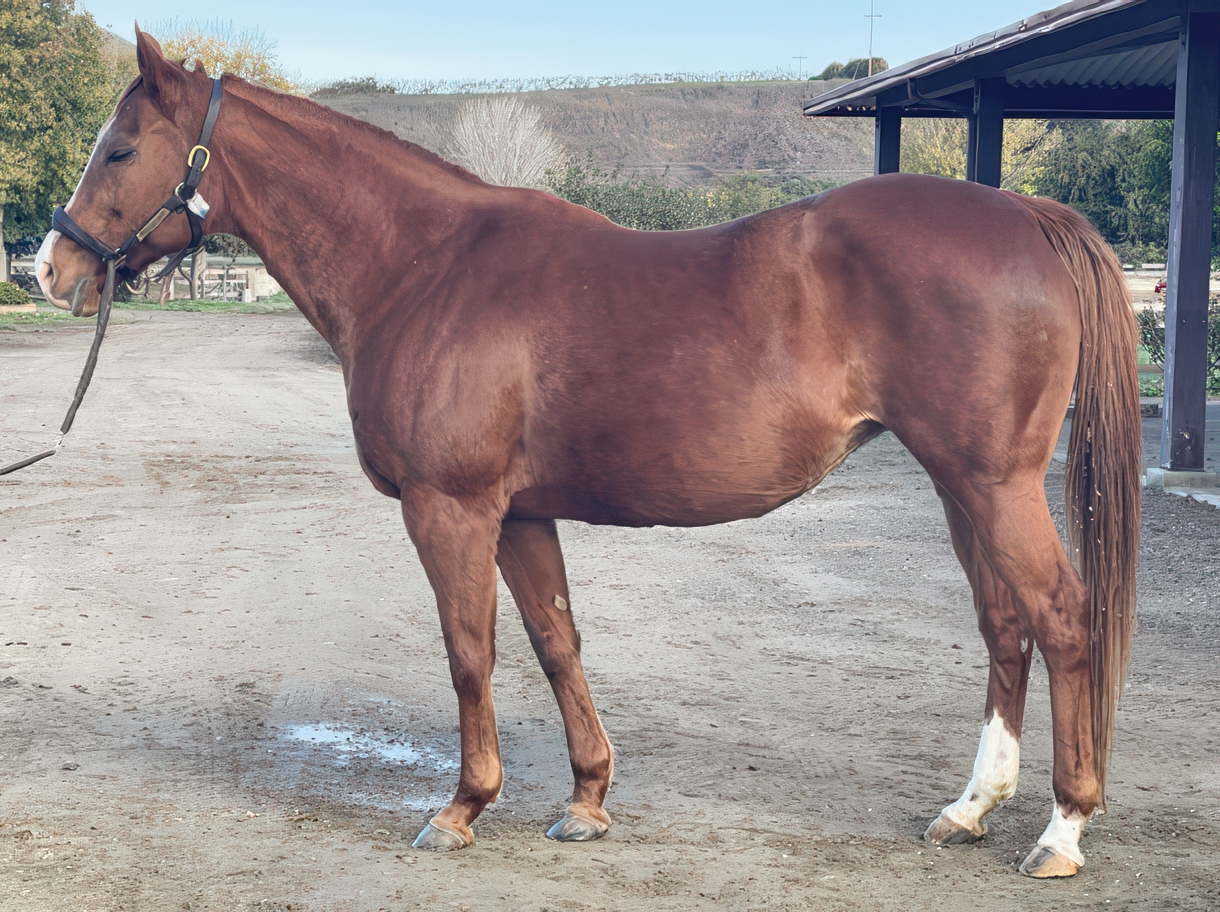
Kathleen Rose is the dam of Man O Rose
Kathleen Rose, Man O Rose’s Cal-bred dam, was graded stakes-placed while earning $342,238 over an 18-race career. Zietz was forced to retire her due to a bronchial infection. But he is convinced that she would have raced much longer otherwise, noting that her full brother, Getoffmyback, made 63 starts with 17 wins.
“You’ve got to be pretty lucky to get a mare like Kathleen Rose,” Zietz said.
Zietz says Man O Rose’s sire, Stanford, a son of Malibu Moon, “is very well bred, a Kentucky-style stallion” who earned more than $1.3 million on the track. “He’s not a pretty horse, but he has a good, strong shoulder.”
The 15-year-old Kathleen Rose is now the only broodmare that Zietz owns. He sold a yearling she delivered by Oscar Performance at Keeneland in September for $65,000 while retaining a 20% share. Kathleen Rose was bred to the multiple graded stakes-winning stallion Fulsome this season.
Though his side career as a breeder may be winding down, Zietz says he’s learned some things along the way.
“For every three dollars you put up, you’ll get back two. The thing you have to do is you have to expect to lose. And then you have to learn from your mistakes.”